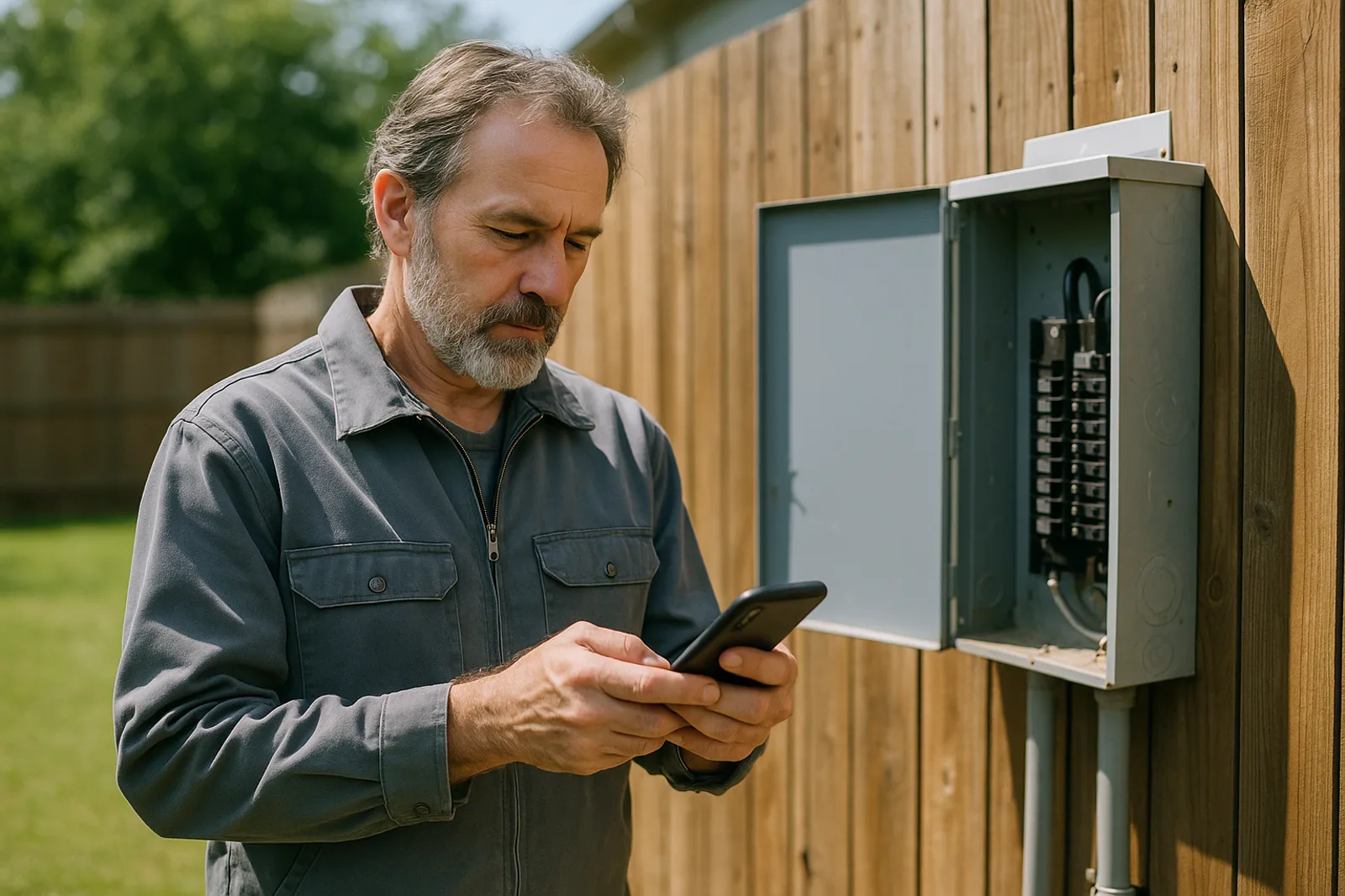
You know that feeling. You’re on site, knee-deep in conduit, and your phone buzzes. It’s a potential client asking, "Can you come out this week for a quote?" You glance at it, tell yourself you’ll reply when you finish this junction box, and then forget about it for three hours. By the time you text back "Yes, absolutely," they’ve already booked someone else.
In the electrical trade, your license and your skills get you the job, but your response time keeps you in business. We obsess over ampacity, voltage drop, and code compliance, yet we often ignore the single most critical wire in our business: the communication line to the customer. If that line has a delay, the circuit breaks, and the job goes to the guy who picked up his phone faster.
Here is the hard truth about why electricians lose jobs to slow text replies—and how to fix it before your phone stops ringing altogether.
The "Speed to Lead" Rule Doesn't Care How Busy You Are
In sales, there is a metric called Speed to Lead. It measures how quickly you respond to an inquiry. For decades, the rule was "the first one to call back wins." Now, with text messaging, the window has shrunk from hours to minutes.
Consider this reality:
78% of customers buy from the first business that responds to their inquiry.
50% of customers choose the first responder, regardless of brand loyalty.
A response time of 5 minutes is 100x more likely to convert a lead than a response time of 30 minutes.
As an electrician, you aren't just competing against the other licensed master electricians in your county. You are competing against the plumber, the roofer, and the HVAC tech who are also blowing up that homeowner’s phone. Homeowners don't think in terms of trade categories; they think in terms of "who can fix my house fastest." If you leave them on "read," you are telling them you don't want the work.
Why "I'll Reply Later" Is a Death Sentence
There is a psychological phenomenon called "choice paralysis." When a homeowner has a flickering light or a dead outlet, they are in a mild state of anxiety. They want the problem solved now. When they text you, they are essentially throwing a rope to the first person who grabs it.
When you delay your reply, you force them to keep looking. You are effectively pushing them toward your competitor.
Here is what happens in the client's brain when you ghost them for an hour:
Doubt: "Did I text the right number?"
Annoyance: "Why are they ignoring me?"
Action: "Let me try the next guy on Google."
Commitment: "Oh, this guy replied immediately and was super professional. Let's go with him."
The electrician who replies in 10 minutes looks like a hero. The electrician who replies in 3 hours looks like a flake. It doesn't matter if you were up on a ladder fixing a panel—the customer doesn't see your work, they only see your silence.
There is a psychological phenomenon called "choice paralysis." When a homeowner has a flickering light or a dead outlet, they are in a mild state of anxiety. They want the problem solved now. When they text you, they are essentially throwing a rope to the first person who grabs it.
When you delay your reply, you force them to keep looking. You are effectively pushing them toward your competitor.
Here is what happens in the client's brain when you ghost them for an hour:
Doubt: "Did I text the right number?"
Annoyance: "Why are they ignoring me?"
Action: "Let me try the next guy on Google."
Commitment: "Oh, this guy replied immediately and was super professional. Let's go with him."
The electrician who replies in 10 minutes looks like a hero. The electrician who replies in 3 hours looks like a flake. It doesn't matter if you were up on a ladder fixing a panel—the customer doesn't see your work, they only see your silence.
The "Breadcrumb" Trap: Short Replies That Kill Deals
Sometimes, it isn't about the speed of the reply, but the content. Many electricians think that replying "I'm busy, can I get you next week?" is a valid response. It isn't.
Slow text replies often come in two forms:
1. The Delayed Full Quote: You take 4 hours to send a detailed estimate, but by then, they've already signed with a competitor.
2. The Terse One-Liner: You reply fast, but with "Can't today. Call tomorrow." This reads as dismissive.
The issue isn't just that you are slow; it's that you are making the customer do all the heavy lifting. If you reply, you need to move the conversation forward. A slow reply that says "I'm booked for 2 weeks" is a job lost. A fast reply that says "I can swing by Thursday at 4 PM, does that work?" is a job secured.
The "After Hours" Conundrum
Let's be honest: electrical emergencies don't happen between 9 AM and 5 PM. They happen at 7 PM when the breaker trips, or on Saturday morning when the GFCI outlet dies.
If a homeowner texts you at 6:30 PM and you don't reply until Monday morning, you have already lost the job to the 24/7 emergency service (who charges double, but at least they answered).
You don't have to be glued to your phone 24/7, but you must have a system to acknowledge the message immediately.
The Auto-Reply: "Thanks for texting. I'm on a job right now. I'll review your project and text back within 30 minutes."
The Quick Acknowledge: Even a simple "Got it. I'm finishing up a service call, but I haven't forgotten you. Give me 20 minutes to look at the calendar."
This buys you time without losing the lead. It manages expectations. The customer isn't angry because you are slow; they are angry because they feel ignored. An immediate acknowledgment removes the "ignored" feeling.
Let's be honest: electrical emergencies don't happen between 9 AM and 5 PM. They happen at 7 PM when the breaker trips, or on Saturday morning when the GFCI outlet dies.
If a homeowner texts you at 6:30 PM and you don't reply until Monday morning, you have already lost the job to the 24/7 emergency service (who charges double, but at least they answered).
You don't have to be glued to your phone 24/7, but you must have a system to acknowledge the message immediately.
The Auto-Reply: "Thanks for texting. I'm on a job right now. I'll review your project and text back within 30 minutes."
The Quick Acknowledge: Even a simple "Got it. I'm finishing up a service call, but I haven't forgotten you. Give me 20 minutes to look at the calendar."
This buys you time without losing the lead. It manages expectations. The customer isn't angry because you are slow; they are angry because they feel ignored. An immediate acknowledgment removes the "ignored" feeling.
How to Win the Job with a Faster Workflow
You are an electrician, not a secretary. You can't be driving and typing out a full proposal. But you can adapt your workflow to prioritize the "reply" over the "fix."
Here is how to restructure your day to stop losing bids:
### 1. The "First 5 Minute" Rule
When you get a lead, stop what you are doing for 60 seconds. Just send a text that says: "Hi [Name], got your message. I'd love to help with that. Are you free for a quick call tomorrow at 9 AM, or would you prefer a text quote?"
This does two things: it confirms you are alive, and it sets a specific time for the next step. You haven't done the work yet, but you've claimed the client.
### 2. Pre-Written Templates
Don't type out full sentences every time. Have a notes app on your phone with pre-written responses for common scenarios.
For Breaker Trips: "I can come out today. My service fee is $X, which covers the first hour. Does that work?"
For New Construction: "I'd love to bid on that. I typically need 20 minutes to walk the site. Are you available Saturday?"
For Panel Upgrades: "Yes, I do those. Do you have a photo of your current panel? I can give you a ballpark figure right now."
This cuts your typing time from 5 minutes to 30 seconds, allowing you to reply fast without being distracted.
### 3. Schedule "Texting Blocks"
If you are on a job site where you legally cannot use your phone (which is often the case on commercial sites), schedule a 10-minute break every hour to check and reply to messages. Set an alarm on your watch. It is better to reply in 50 minutes than in 3 hours.
You are an electrician, not a secretary. You can't be driving and typing out a full proposal. But you can adapt your workflow to prioritize the "reply" over the "fix."
Here is how to restructure your day to stop losing bids:
### 1. The "First 5 Minute" Rule
When you get a lead, stop what you are doing for 60 seconds. Just send a text that says: "Hi [Name], got your message. I'd love to help with that. Are you free for a quick call tomorrow at 9 AM, or would you prefer a text quote?"
This does two things: it confirms you are alive, and it sets a specific time for the next step. You haven't done the work yet, but you've claimed the client.
### 2. Pre-Written Templates
Don't type out full sentences every time. Have a notes app on your phone with pre-written responses for common scenarios.
For Breaker Trips: "I can come out today. My service fee is $X, which covers the first hour. Does that work?"
For New Construction: "I'd love to bid on that. I typically need 20 minutes to walk the site. Are you available Saturday?"
For Panel Upgrades: "Yes, I do those. Do you have a photo of your current panel? I can give you a ballpark figure right now."
This cuts your typing time from 5 minutes to 30 seconds, allowing you to reply fast without being distracted.
### 3. Schedule "Texting Blocks"
If you are on a job site where you legally cannot use your phone (which is often the case on commercial sites), schedule a 10-minute break every hour to check and reply to messages. Set an alarm on your watch. It is better to reply in 50 minutes than in 3 hours.
The Hidden Cost of the "Slow Reply"
Many electricians think that losing one job to a slow reply is just a minor setback. But it is actually a compounding loss.
The average residential electrical job is worth $500 - $1,500.
If you lose 2 jobs per month to slow replies, you're losing $24,000 - $36,000 a year.
Word-of-mouth referrals account for 40% of electrical work. A potential client who felt snubbed by your slow reply is likely to tell their neighbors not to call you.
You aren't just losing the immediate job; you are losing the referral network attached to that job. That homeowner is going to complain to their friends about how "hard it was to get ahold of you" before they even mention your electrical prowess.
The Rise of the "Instant Gratification" Homeowner
The modern homeowner is used to ordering a pizza and tracking it on a map. They are used to Uber showing them exactly where the driver is. When they text a contractor, they expect a similar level of immediacy.
If you don't provide that immediacy, they will assume you are either too busy (and thus, too expensive) or too disorganized (and thus, risky to hire). Neither assumption is good for your bottom line.
To survive, you need to stop treating your phone like a tool you use between jobs, and start treating it like the cash register it is. Every text is a potential invoice.
The Bottom Line
Your electrical work might be flawless, but if your text replies are slow, you are shooting yourself in the foot. Speed is a feature. When a client asks for a quote, they are asking for permission to hire you. If you take too long to grant that permission, they will find someone else who will.
Stop losing bids to the electrician who simply answered his phone faster. Prioritize the reply, even if it's just a quick "Got it, I'll call you in 10." A fast text builds trust; a slow text builds frustration.
If you want to get back to pulling wire instead of typing out quotes, consider using a text assistant for contractors to handle the initial response, qualify the lead, and schedule the site visit while you keep your head in the panel. Let the machine handle the speed, so you can handle the craft. Your next job depends on it.
Prybar helps trade businesses never miss a customer text again. Responds instantly, captures leads, books jobs — all while you work. Live in minutes.
Get Started →